
How thoughtful material selection, furniture reuse, energy-efficient systems, and integrated construction can create more responsible workplaces without compromising functionality or business value.
Sustainability has become an increasingly important consideration in corporate workplace development. As businesses evaluate their environmental responsibilities and long-term operating costs, office design and construction are no longer assessed solely on appearance, functionality, and initial investment.
The materials selected, furniture retained, energy systems installed, and construction methods adopted can all influence the environmental impact of a workplace.
However, a sustainable office fit-out does not necessarily require expensive technology, elaborate green features, or a complete replacement of existing interiors.
Often, the most meaningful improvements begin with practical decisions: retaining usable furniture, selecting durable materials, reducing unnecessary construction waste, and designing spaces that can adapt to future business needs.
For organisations planning an office renovation or new office fit-out in Indonesia, sustainability should be integrated into the project from the beginning.
At Amertacorona, we believe that responsible interior design and construction starts with understanding what a business needs, what resources are already available, and how to deliver lasting value.
1. What Is a Sustainable Office Fit-Out?
A sustainable office fit-out is the process of designing and constructing a workplace while considering its environmental impact, resource efficiency, operational performance, and long-term usability.
It involves decisions throughout the project lifecycle, from initial planning and material procurement to construction, occupancy, maintenance, and future renovation.
A sustainable office fit-out may incorporate:
- Reuse and refurbishment of existing furniture.
- Responsible selection of interior materials.
- Energy-efficient lighting and building systems.
- Efficient space planning and adaptable layouts.
- Construction waste reduction and segregation.
- Durable finishes that reduce premature replacement.
- Indoor environmental quality considerations.
- Maintenance and lifecycle cost planning.
The objective is not simply to create an office that looks environmentally friendly.
It is to make informed choices that reduce avoidable resource consumption while maintaining the workplace's intended performance.
Sustainability is not defined by how many green products are installed. It is reflected in how responsibly resources are used throughout the life of the workplace.
2. Start with What You Already Have
One of the most practical sustainability strategies in office renovation is evaluating existing assets before purchasing replacements.
Corporate relocations and renovations often involve substantial quantities of workstations, chairs, storage cabinets, meeting tables, and other furniture.
Replacing everything may appear convenient, particularly when developing a new interior concept.
However, many existing assets may still have functional value.
Conduct a Furniture and Asset Assessment
Before finalising the design, businesses should identify which assets can be:
- Retained without modification.
- Refurbished or repaired.
- Reconfigured for new workplace layouts.
- Reupholstered or refinished.
- Repurposed for different functions.
- Responsibly recycled or disposed of when reuse is not feasible.
The assessment should consider structural condition, ergonomics, dimensions, materials, safety, maintenance, and compatibility with the proposed design.
Integrate Existing Assets into the New Design
Furniture reuse should not be treated as an afterthought.
When existing assets are assessed during concept development, designers can create layouts and specifications that incorporate them appropriately.
This approach can help reduce unnecessary purchases and disposal while preserving value from previous investments.
A Practical Example: BLP Beauty Headquarters
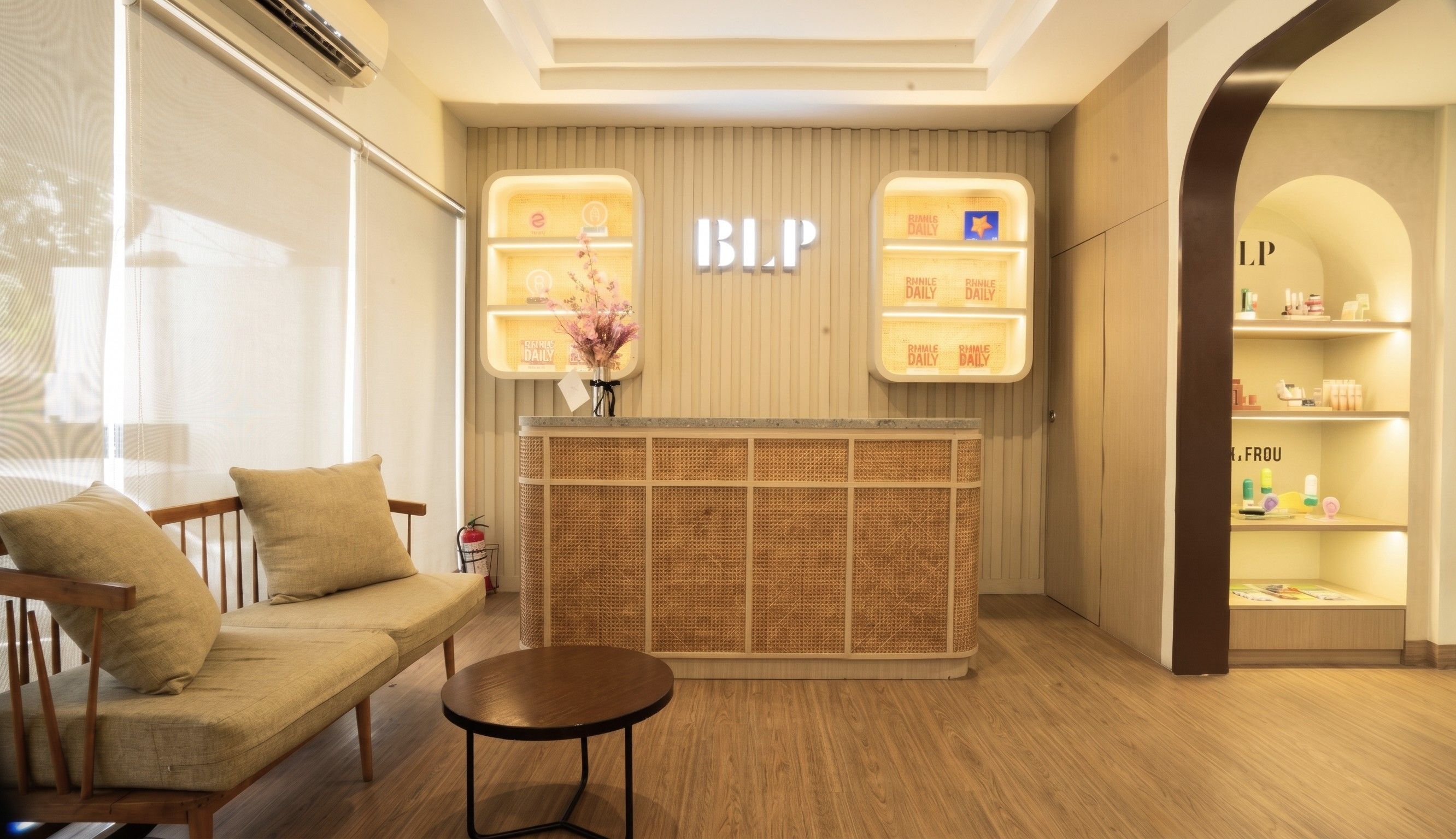
In the BLP Beauty headquarters project, Amertacorona explored how existing furniture could be incorporated into the new workplace rather than automatically replacing it.
Furniture was evaluated based on functionality, dimensions, materials, and compatibility with the design.
Suitable assets were adapted to serve the requirements of the new office.
The project illustrates a practical principle: before deciding what to replace, first understand what can still be used.
3. Choose Materials for Durability, Not Just Appearance
Material selection is central to sustainable interior construction.
While recycled content and environmental certifications can be useful considerations, material sustainability should also be evaluated through durability, maintenance, suitability, and expected service life.
A material that requires frequent replacement may create unnecessary waste and additional costs.
Prioritise Long-Term Performance
For high-traffic corporate environments, consider materials that can withstand regular use and appropriate cleaning.
This applies to flooring, wall finishes, work surfaces, joinery, and furniture components.
Consider Responsible Sourcing
Where appropriate, project teams can evaluate:
- Verified recycled content.
- Responsibly sourced timber and wood products.
- Relevant environmental product documentation.
- Low-emitting paints, adhesives, and finishes.
- Locally available materials where suitable.
- Product repairability and replacement options.
Environmental claims should be supported by supplier documentation rather than marketing descriptions alone.
Evaluate Maintenance Requirements
Some materials may appear attractive at installation but require intensive cleaning, specialised maintenance, or frequent replacement.
A responsible specification should consider the resources required to maintain the material throughout its intended life.
The most sustainable material is not always the newest or most innovative. It may be the one that performs reliably for the longest appropriate period.
4. Reduce Construction Waste Through Better Planning
Office fit-out construction generates waste from packaging, offcuts, demolition, material replacement, and installation activities.
Some waste is unavoidable, but unnecessary waste can often be reduced through better coordination.
Improve Design Accuracy
Clear construction drawings and coordinated specifications can help minimise errors that result in rework.
Optimise Material Quantities
Accurate measurement, procurement planning, and fabrication methods can reduce excessive ordering and material offcuts.
Coordinate Procurement and Deliveries
Well-planned deliveries can reduce material damage, unnecessary storage, and replacement requirements.
Segregate Waste Where Practical
Construction waste may include timber, metal, cardboard, plastics, glass, and other materials.
Where suitable collection and recycling services are available, segregation can support more responsible handling.
However, recycling outcomes depend on local waste-management capabilities and the actual processing of collected materials.
Plan for Selective Demolition
During renovation, existing partitions, finishes, and furniture should be assessed before removal.
Selective demolition can help preserve components that remain useful.
Waste reduction is most effective when considered during design and procurement—not only after construction has started.
5. Design for Energy Efficiency
Energy performance is an important consideration in sustainable office interiors, particularly in Indonesia's tropical climate.
Lighting, air-conditioning, equipment, and workplace operating patterns all influence electricity consumption.
Energy-Efficient Lighting
LED lighting can offer energy-efficiency advantages when appropriately specified.
However, effective lighting design requires more than selecting low-wattage fixtures.
Designers should consider task requirements, illuminance, glare, colour rendering, fixture efficiency, control systems, and maintenance.
Occupancy sensors, daylight-responsive controls, and zoning may provide additional opportunities to manage energy use.
HVAC Coordination
Air-conditioning can represent a significant operational consideration in commercial offices.
Interior layouts should be coordinated with existing HVAC systems to avoid inappropriate air distribution, inaccessible equipment, or unnecessary system modifications.
Where technically feasible, appropriate controls and scheduling may help reduce avoidable operation.
Make Use of Natural Daylight
Daylight can reduce the need for artificial lighting under suitable conditions.
However, large glazed areas can also introduce solar heat gain and glare.
In Indonesia, daylight planning should therefore be balanced with shading, glazing performance, thermal comfort, and cooling requirements.
Measure Performance Where Possible
Energy-saving claims should be supported by relevant calculations, monitoring, or operational data.
The presence of efficient equipment alone does not guarantee a particular level of energy reduction.
6. Plan Flexible Workplaces That Last Longer
A sustainable office should accommodate reasonable organisational change without requiring extensive reconstruction.
Businesses evolve. Teams grow, departments change, and workplace practices develop.
When an interior is designed only for immediate requirements, future changes may result in premature demolition and replacement.
Flexible Space Planning
Modular partitions, adaptable meeting rooms, and reconfigurable furniture can support changes in workplace requirements.
Standardised Furniture Components
Where appropriate, standardised components may simplify repairs, replacement, and future reconfiguration.
Accessible Technical Infrastructure
Electrical, data, and other building services should be planned with maintenance and reasonable future modifications in mind.
Avoid Unnecessary Over-Specification
Not every office needs the most elaborate finishes or sophisticated technology.
Design decisions should reflect actual operational needs and expected use.
A workplace that can adapt to change may avoid unnecessary reconstruction and preserve value over time.
7. Improve Indoor Environmental Quality
Sustainable office design should also consider the quality of the indoor environment.
Employee comfort and workplace usability depend on several interconnected factors.
Lighting and Visual Comfort
Appropriate lighting supports visibility and reduces unnecessary visual discomfort.
Acoustic Performance
Meeting rooms, collaborative spaces, and individual work areas may require different acoustic conditions.
Sound-absorbing materials and thoughtful zoning can help manage noise.
Thermal Comfort
Temperature, humidity, air movement, and occupancy should be considered alongside HVAC system capabilities.
Indoor Air Quality
Material emissions, ventilation, cleaning products, and maintenance practices can influence indoor air quality.
Low-emitting materials and appropriate ventilation strategies may contribute to better indoor environmental conditions.
Ergonomics and Space Planning
Furniture selection, circulation, workstation dimensions, and accessibility should support the practical needs of employees.
A sustainable workplace should not sacrifice comfort or functionality to achieve environmental objectives.
8. Sustainable Office Design in Indonesia: Practical Considerations
Implementing sustainable office fit-out strategies in Indonesia requires an understanding of local conditions.
Tropical Climate
High temperatures and humidity influence material selection, thermal comfort, HVAC requirements, and maintenance.
Existing Commercial Buildings
Many corporate fit-out projects take place within leased office towers.
Building management requirements and existing technical systems may limit certain modifications.
Material Availability
Sustainable material options should be assessed for local availability, lead times, documentation, cost, and long-term supply.
Waste-Management Infrastructure
The feasibility of recycling and material recovery depends on the availability of suitable service providers and processing facilities.
Project Budget and Procurement
Sustainability objectives should be established early enough to influence design and procurement decisions.
Late changes can introduce unnecessary costs or construction delays.
A practical sustainability strategy should respond to the project's actual context rather than rely on a standard checklist applied to every office.
9. Understand the Difference Between Sustainable Design and Green Certification
Sustainable design principles can be applied to office projects regardless of whether formal certification is pursued.
However, green building certification provides a structured framework for assessing defined environmental and performance criteria.
In Indonesia, the Green Building Council Indonesia develops GREENSHIP rating tools relevant to different building and interior project types.
For projects pursuing certification, requirements should be reviewed at the beginning of the design process.
Certification may involve specific documentation, technical performance criteria, material evidence, and verification procedures.
It is important to distinguish between:
Sustainable Design Practices
Practical measures adopted to improve resource efficiency, durability, environmental quality, and lifecycle performance.
Green Building Certification
A formal assessment against defined criteria administered through an applicable certification programme.
A project should not be described as certified unless the relevant certification has actually been achieved.
10. Evaluate Sustainability Through Lifecycle Value
Initial construction cost is important, but it is not the only financial consideration.
A responsible office fit-out should also account for the costs and resources associated with operating and maintaining the workplace.
These may include:
- Electricity consumption.
- Routine maintenance.
- Furniture repair and replacement.
- Cleaning and material care.
- Equipment servicing.
- Future layout modifications.
- End-of-life disposal or material recovery.
A product with a higher initial price may provide better long-term value if it lasts longer or requires less maintenance.
Conversely, an expensive sustainability feature may offer limited practical benefit if its operating requirements are disproportionate to its purpose.
Lifecycle evaluation helps clients make decisions based on overall value rather than purchase price alone.
11. Why Integrated Design and Build Supports Sustainable Fit-Outs
Sustainability decisions affect multiple project disciplines.
Material selection influences procurement and construction methods. Lighting choices affect electrical design. Space planning affects HVAC distribution. Furniture reuse influences layouts, detailing, and installation.
When these decisions are developed independently, opportunities for coordination may be missed.
An integrated design and build approach brings architectural, engineering, procurement, and construction considerations together earlier.
This can support:
- Evaluation of existing assets before replacement.
- Better material and quantity planning.
- Coordination of energy-related systems.
- Identification of buildability issues.
- Reduced avoidable rework.
- Clearer documentation of sustainability requirements.
- More informed cost and performance comparisons.
Sustainability is most effective when it becomes part of project decision-making rather than a separate decorative or marketing objective.
12. Common Mistakes in Sustainable Office Fit-Out Projects
Several common mistakes can undermine sustainability objectives.
Replacing usable furniture unnecessarily
Existing assets may still provide value through reuse, repair, or adaptation.
Selecting materials based only on green marketing claims
Environmental claims should be supported by appropriate evidence.
Ignoring maintenance requirements
Complex installations may create additional resource consumption and operating costs.
Focusing only on initial construction cost
Low initial prices may be offset by premature replacement or high maintenance requirements.
Introducing sustainability goals too late
Late decisions may require redesign, procurement changes, or additional construction work.
Assuming greenery automatically makes an office sustainable
Indoor planting may contribute to workplace experience, but sustainability requires a broader assessment of environmental impacts.
Claiming environmental benefits without measurement
Specific performance claims should be supported by calculations, monitoring, or verifiable project data.
The most effective approach is to define clear objectives and evaluate each design choice against them.
13. Amertacorona's Approach to Sustainable Interior Solutions
At Amertacorona, we believe that responsible interior design and construction should balance business requirements, resource efficiency, technical performance, and long-term value.
Established in 2016, PT Amerta Corona Sahabat Indonesia provides integrated interior design and construction solutions for corporate and commercial environments.
Our services include workplace planning, office interior design, fit-out construction, renovation, MEP coordination, project management, and custom furniture solutions.
Our experience includes the BLP Beauty headquarters project, where existing furniture was assessed for adaptation into the new workplace.
We have also delivered the Wahana Honda headquarters project at Gunung Sahari, which received a GREENSHIP Innovation Award in 2025.
These experiences reflect the importance of considering sustainability through practical design and construction decisions.
Our integrated design and build approach helps connect architectural planning, material selection, technical coordination, and project delivery.
The objective is to develop workplaces that support business needs while making responsible use of available resources.
Sustainability Begins with Better Decisions
A sustainable office fit-out does not have to begin with expensive technology or dramatic architectural features.
It can begin with a simpler question:
What can we design, build, retain, or improve more responsibly?
By evaluating existing assets, choosing durable materials, planning efficient systems, reducing waste, and designing adaptable workplaces, businesses can make more informed decisions about their office investments.
Sustainability is not a single product or design feature.
It is the result of thoughtful choices made throughout the project lifecycle.
The most sustainable office is not necessarily the one built with the most new green products. It may be the one that makes the best use of what already exists.
At Amertacorona, our mission is to elevate workplace experiences through world-class interior solutions.
Frequently Asked Questions
What is a sustainable office fit-out?
A sustainable office fit-out is the design and construction of a workplace with consideration for resource efficiency, responsible materials, energy performance, waste reduction, indoor environmental quality, and long-term usability.
Is a sustainable office fit-out more expensive?
Not necessarily. Some measures may require additional initial investment, while others—such as furniture reuse or avoiding unnecessary construction—may reduce costs. Financial outcomes depend on the specific project and lifecycle requirements.
How can an existing office become more sustainable?
An existing office can be improved through selective renovation, furniture reuse, lighting upgrades, better space planning, durable material selection, and appropriate building-system coordination.
What materials are suitable for sustainable office interiors?
Suitable materials may include durable products with verified environmental documentation, responsibly sourced wood, recycled-content products, and low-emitting finishes. Selection should also consider functionality, maintenance, and expected service life.
Is GREENSHIP certification required for sustainable office design in Indonesia?
No. Sustainable design practices can be implemented without formal certification. GREENSHIP certification is a separate process involving assessment against applicable criteria.
Can office furniture be reused during renovation?
Yes. Existing furniture can often be retained, repaired, refurbished, or adapted, provided it remains safe, functional, and compatible with the new workplace design.
How can a contractor help reduce office construction waste?
Contractors can support waste reduction through accurate material planning, coordinated drawings, selective demolition, responsible procurement, and appropriate waste segregation and handling.
Planning a Sustainable Office Fit-Out in Indonesia?
Whether your organisation is relocating, renovating, or developing a new corporate workplace, sustainable design choices can help create more responsible and adaptable interiors.
Amertacorona provides integrated office interior design and fit-out construction solutions for corporate and commercial clients.
Explore Amertacorona to discuss your next office project with our team.